If you’ve been dealing with knee pain, a frozen shoulder, or a nagging heel ache for months (sometimes years) and nothing seems to fix it, you’re not alone. Painkillers wear off. Rest helps for a week, then the pain creeps back. Generic physiotherapy gets you partway there and then plateaus. At some point, most people start asking a more specific question: is there a treatment that actually addresses what’s causing the pain, not just the symptom?
That’s where regenerative therapy comes in. Instead of masking pain or pushing straight to surgery, these treatments work by stimulating your body’s own repair processes at the tissue level. In Dhaka, ACRT BD (Advanced Centre for Regenerative Therapy) is one of the clinics offering this kind of non-surgical approach, using shockwave therapy, radiofrequency treatment, and injection-based therapies to target chronic joint and soft tissue pain.
This guide walks through what regenerative therapy actually does, how the main treatment options differ, which one tends to fit which condition, and what to expect if you decide to look into it.
What Causes Chronic Pain That Won’t Go Away
Chronic pain, generally defined as pain lasting more than three months, is often different from an acute injury. With something like a sprained ankle, your body’s natural healing process kicks in and resolves the damage over a few weeks. Chronic conditions like tendinopathy (a term covering both tendinitis and tendinosis), osteoarthritis, or a frozen shoulder are different. The tissue damage has outpaced or outlasted the body’s own repair capacity, so the area stays inflamed, weak, or degraded rather than healing on its own.
This is why rest alone often doesn’t work for chronic cases. There isn’t enough active healing happening to fix the underlying problem. Regenerative treatments are designed to reignite that healing response directly at the site of damage.
Book a Consultation: https://acrtbd.com/contact/
What Is Regenerative Therapy, in Plain Terms
Regenerative therapy is a category of non-surgical treatments that stimulate your body’s natural repair mechanisms rather than replacing or removing damaged tissue. Instead of medicating around the pain, these therapies trigger new blood vessel formation, collagen production, or tissue regeneration in the specific area that’s damaged.
At ACRT BD, this takes the form of four main approaches: extracorporeal shockwave therapy (ESWT), TECAR radiofrequency, viscosupplementation, and platelet-rich plasma (PRP) therapy. Each works differently, and each tends to suit different types of chronic pain.
The Four Main Treatment Options, Explained
Extracorporeal Shockwave Therapy (ESWT)
ESWT uses focused, low-intensity shockwaves delivered through the skin to the injured area. The waves create controlled micro-trauma in the tissue, which sounds counterintuitive, but this is exactly what triggers the body to respond: new blood vessels form, blood flow to the area improves, and the tissue’s own repair processes get switched back on.
ESWT is one of the more extensively studied regenerative therapies. A systematic review and meta-analysis published in Scientific Reports looked at focused and radial shockwave therapy for tendinopathy and found that <cite index=”19-1″>focused shockwave therapy showed a statistically significant advantage over radial shockwave therapy for reducing pain, particularly at mid-term follow-up</cite>. Other reviews have found similar support for ESWT in conditions like Achilles tendinopathy and plantar fasciitis, though researchers are generally careful to note that <cite index=”17-1″>the evidence base, while growing, is still described as inconclusive for some conditions</cite>, so it’s not treated as a guaranteed fix for every case.
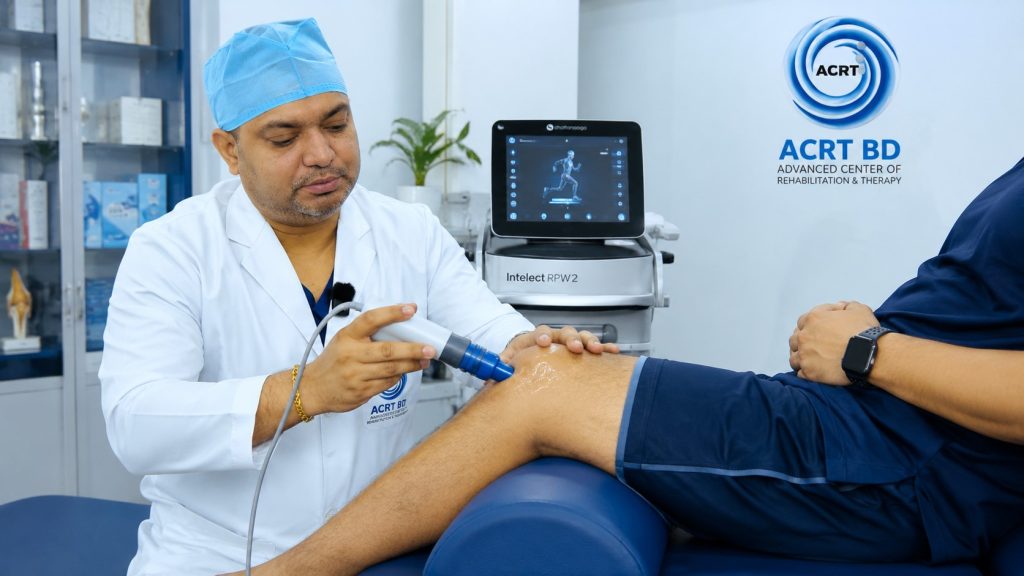
ESWT is delivered in a clinic setting without anesthesia, using a handheld device pressed against the treatment area. ACRT BD notes on their site that most patients notice improvement within a few weeks, though this varies by condition and individual response. You can read more on their shockwave therapy page.
TECAR Radiofrequency
TECAR (Transfer Electrical Capacitive and Resistive) uses high-frequency electrical currents, typically in the 300 kHz to 1 MHz range, to generate heat within the tissue itself rather than on the skin’s surface. This internal heating boosts local circulation and cellular activity, which supports faster tissue repair.
TECAR is applied in two modes. Capacitive mode targets soft tissue and muscle, working through more superficial layers. Resistive mode reaches deeper into bone, joint, and tendon structures, where resistance to the current generates more concentrated heat. Which mode gets used depends on where the damage actually is, not just where the pain is felt (these aren’t always the same place).
More detail on this is available on ACRT BD’s TECAR radiofrequency page.
Viscosupplementation
Viscosupplementation involves injecting hyaluronic acid directly into a joint, most commonly the knee. Hyaluronic acid is naturally present in joint fluid, where it acts as a lubricant and shock absorber. In osteoarthritis, the joint’s natural hyaluronic acid breaks down and thins out, which is part of why movement becomes painful and joints feel stiff or “grinding.”
The injection restores some of that cushioning and lubrication, which can reduce friction between bones and ease pain during movement. It’s a targeted, joint-specific treatment rather than a whole-body one. Details are on the viscosupplementation page.
Platelet-Rich Plasma (PRP) Therapy
PRP uses a concentrated dose of your own platelets, drawn from a small blood sample, spun down to isolate the platelet-rich portion, then injected back into the injured area. Platelets contain growth factors that play a central role in tissue repair, and concentrating them at the injury site is meant to accelerate and intensify the body’s own healing response.
Because PRP is derived from your own blood, it carries a different risk profile than synthetic injections. It’s often considered for tendon and soft tissue injuries where the tissue has more capacity for repair but needs a stronger signal to get started. More information is on the PRP therapy page.
Comparing the Four Treatments
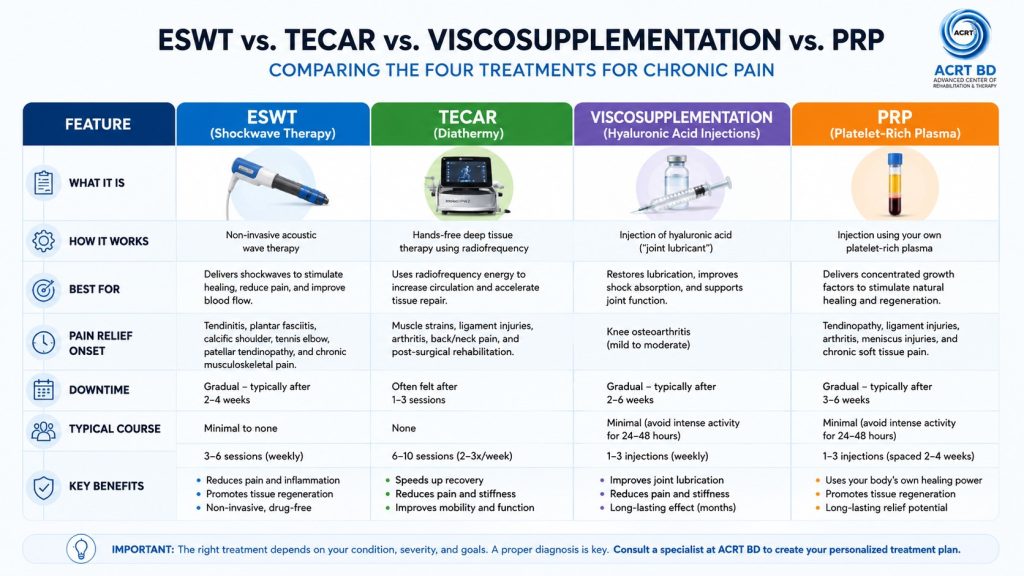
| Treatment | How It Works | Best Suited For | Invasiveness |
|---|---|---|---|
| ESWT | Shockwaves trigger micro-trauma and new blood vessel growth | Tendinopathy, plantar fasciitis, tennis/golfer’s elbow, calcific tendinitis | Non-invasive, no injection |
| TECAR Radiofrequency | High-frequency current generates internal heat to boost circulation | Muscle, tendon, and joint conditions; often paired with other treatments | Non-invasive, no injection |
| Viscosupplementation | Hyaluronic acid injection restores joint lubrication | Knee osteoarthritis specifically | Minimally invasive, single-joint injection |
| PRP Therapy | Concentrated platelets from your own blood stimulate tissue repair | Tendon and soft tissue injuries needing a stronger regenerative signal | Minimally invasive, blood draw and injection |
Book a Consultation: https://acrtbd.com/contact/
Which Treatment Fits Which Condition
This is where a lot of people get stuck. The names all sound similar, and most clinic websites just list the four treatments without explaining which one fits which problem. Here’s a rough framework, though the actual choice always comes down to a real clinical assessment:
- Knee osteoarthritis: Often addressed with viscosupplementation, sometimes combined with PRP if there’s also soft tissue involvement.
- Tendon-related pain (tennis elbow, golfer’s elbow, plantar fasciitis, Achilles tendinitis): ESWT is commonly used here, sometimes alongside TECAR for deeper tissue involvement.
- Frozen shoulder: May involve a combination of TECAR and ESWT, depending on how restricted the joint is and where the inflammation is concentrated.
- Disc prolapse (PLID) or avascular necrosis of the hip (AVN): These involve more complex structures and typically require a full clinical evaluation before any treatment is recommended. This isn’t something to self-diagnose from a list online.
If your condition doesn’t map neatly onto one of these categories, that’s normal. It’s also exactly why an in-person assessment matters more than guessing from a website. ACRT BD also has a dedicated knee pain and joint pain page that walks through osteoarthritis, frozen shoulder, plantar fasciitis, and AVN in more depth (available in Bangla).
Common Mistakes People Make With Chronic Pain
Waiting too long before seeking treatment. The longer tissue stays in a degraded state, the harder it can be to reverse. Many people try to push through pain for months before looking into targeted options.
Assuming all “shockwave therapy” is the same. Focused and radial shockwave therapy aren’t identical, and neither is TECAR, even though people sometimes lump them together. The mechanism, depth of effect, and ideal use case differ.
Expecting results after one session. Regenerative therapies work by stimulating a biological process, not by flipping a switch. Most protocols involve multiple sessions spaced over weeks.
Skipping the diagnostic conversation. Two people with “knee pain” can have completely different underlying issues. A treatment that works well for one might do nothing for the other if the root cause isn’t the same.
What to Expect at a Consultation
If you’re considering this kind of treatment, here’s roughly what it looks like:
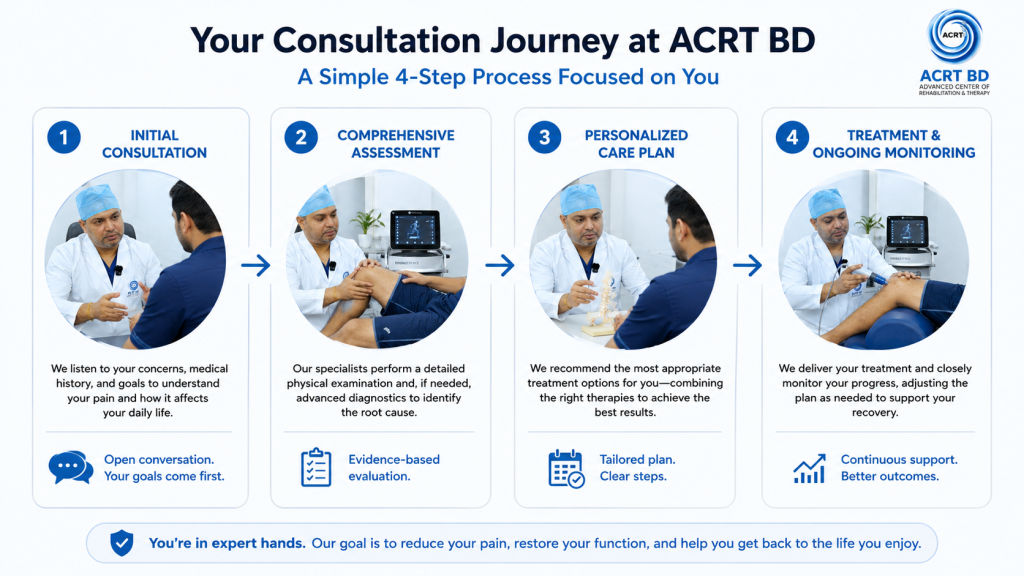
- Initial consultation. You describe your symptoms, history, and what you’ve already tried.
- Assessment and diagnosis. The clinician evaluates the affected area to identify the specific tissue or joint issue driving the pain.
- Personalized care plan. Based on the diagnosis, a treatment (or combination of treatments) is recommended, along with an expected timeline.
- Ongoing monitoring. Progress gets tracked across sessions, with adjustments made if the initial approach isn’t producing the expected response.
At ACRT BD, this process is led by Mr. Shamsul Hoque Nadim, a physiotherapist (BPT, Dhaka University) and certified member of the International Society for Medical Shockwave Treatment (ISMST), with around a decade of clinical experience in this field.
Is Regenerative Therapy Safe?
Generally, yes, though safety depends on proper diagnosis and technique, as with any medical treatment. ESWT and TECAR are non-invasive and don’t involve needles. Viscosupplementation and PRP involve injections, which carry the standard, low risks associated with any injection procedure (minor swelling, temporary soreness at the injection site).
None of these treatments work identically for every patient or every condition. How well they work depends on how severe the underlying damage is, how long you’ve had it, and how your body responds. If you’re dealing with something like nerve compression or structural instability, rather than typical soft tissue or joint wear, that needs to be ruled in or out by a clinician first. These treatments aren’t something to self-select from a list.
This article is for general educational purposes and isn’t a substitute for a professional medical evaluation. If you’re dealing with chronic pain, a proper in-person assessment is the only reliable way to know which treatment, if any, is right for your specific condition.
Frequently Asked Questions
Is shockwave therapy painful? Most patients describe it as uncomfortable rather than painful, similar to a series of sharp taps or pulses on the skin. It’s done without anesthesia and most people tolerate it without difficulty.
How long until I see results? This varies by condition and individual, but ACRT BD notes that many patients notice improvement within a few weeks of starting treatment. Full results typically build over a course of sessions rather than appearing after just one visit.
What’s the difference between PRP and shockwave therapy? PRP involves injecting a concentrated dose of your own platelets directly into the damaged tissue to stimulate repair. Shockwave therapy uses mechanical pulses delivered through the skin, without any injection, to trigger the same kind of repair response. They can sometimes be used together depending on the condition.
Is regenerative therapy a substitute for surgery? Not always, and it depends entirely on the severity and type of the condition. For many soft tissue and early-to-moderate joint conditions, it can reduce or eliminate the need for surgical intervention. For more advanced structural damage, surgery may still be the appropriate path, which is why a proper diagnosis comes first.
Getting Started
If persistent pain has been limiting how you move, work, or sleep, it’s worth getting a proper assessment rather than continuing to guess at solutions. ACRT BD is located at House-190 (Ground Floor), Lane/Road-2, Baridhara DOHS, Gulshan, Dhaka-1206, and is open Saturday through Thursday, 11:00 AM to 7:00 PM (Friday is reserved for emergencies).
You can explore all four chronic pain treatment options in more detail, or reach out directly via WhatsApp at 01977656237 or through their contact page to schedule a consultation.
Book a Consultation: https://acrtbd.com/contact/