If you’ve started researching erectile dysfunction treatment, you’ve probably noticed there’s no shortage of options. Pills, vacuum devices, injections, shockwave therapy, lifestyle changes. Every website seems to push a different one as “the answer.”
Here’s the honest truth: there isn’t one non-surgical ED treatment that works best for everyone. What works well for a 35-year-old dealing with stress-related ED is often the wrong choice for a 60-year-old with diabetes and reduced blood flow. The right treatment depends on what’s actually causing your ED, how severe it is, and what you’re comfortable with.
This article walks through the main non-surgical options, compares them side by side, and gives you a practical way to think about which one fits your situation. None of this replaces a proper medical evaluation, but it should help you walk into that conversation with your doctor already knowing what questions to ask.
Book a Consultation: https://acrtbd.com/contact/

What Counts as a Non-Surgical ED Treatment?
Non-surgical ED treatments are any approach that improves erectile function without implanting a device or altering penile anatomy through surgery. This includes oral medications, physical devices, injectable therapies, energy-based treatments like shockwave therapy, and lifestyle or psychological interventions.
Surgery, mainly penile implants, is generally considered a last resort. It’s effective, but it’s also permanent and irreversible. Because of that, doctors almost always start with non-surgical approaches first, unless there’s a specific medical reason to skip straight to surgery.
Why Non-Surgical Options Are Usually the First Step
Most men respond well enough to non-surgical treatment that surgery never becomes necessary. There are a few reasons doctors default to this approach:
- Lower risk. None of the non-surgical options carry the risks that come with anesthesia and permanent implants.
- Reversibility. If a treatment doesn’t work or causes side effects, you can stop and try something else. You can’t undo a penile implant.
- Cost. Non-surgical treatments are almost always cheaper, at least in the short term.
- Effectiveness for most cases. For mild to moderate ED, especially when the cause is vascular, hormonal, or psychological rather than structural, non-surgical treatment often works well enough that surgery isn’t needed.
Surgery tends to come into the picture only when other options have been tried without success, or when there’s significant physical damage to erectile tissue that non-surgical treatment can’t address.
The Main Non-Surgical ED Treatment Options
Let’s go through each one. For each, I’ll cover how it works, who it tends to suit, and what its limitations are.
Oral Medications (PDE5 Inhibitors)
This is where almost every man starts, and for good reason. Drugs like sildenafil and tadalafil work by relaxing blood vessels in the penis, which makes it easier to get and maintain an erection when you’re sexually stimulated. They don’t cause an erection on their own. You still need arousal for them to do anything.
PDE5 inhibitors work most effectively in men whose ED has a clear circulatory component without severe vascular damage, and they tend to work consistently for men with mild to moderate ED. They’re also widely available and relatively easy to get prescribed.
The catch is that they manage the symptom rather than the underlying cause, so the effect wears off once the drug clears your system. Men with significant nerve damage, severe cardiovascular disease, or certain other conditions often find these medications provide little benefit. Some men also deal with side effects like headaches or flushing, and there are important interactions to check if you’re on certain heart medications.
Best for: Men with mild to moderate ED, particularly when the cause is vascular and not severe, who want an on-demand solution before intimacy.
Vacuum Erection Devices (VEDs)
A vacuum erection device is a plastic cylinder placed over the penis. A pump creates a vacuum that draws blood into the tissue, producing an erection, which is then maintained using a constriction ring placed at the base.
VEDs are non-invasive, drug-free, and don’t interact with any medications. That makes them appealing for men who can’t take PDE5 inhibitors for medical reasons, such as those on certain heart medications or nitrates.
The downside is that the mechanics take some getting used to, and many men find the process less spontaneous than a pill. The erection also feels and looks slightly different since blood is being pulled in mechanically rather than through the body’s normal response to arousal.
Best for: Men who can’t safely use oral medications, or who want a non-drug option and don’t mind a bit of a learning curve.
Low-Intensity Shockwave Therapy
Shockwave therapy, sometimes called Li-ESWT, uses low-intensity acoustic waves applied to the penis. The idea is that this stimulates blood vessel growth and improves circulation over time, rather than just producing a temporary effect like medication does.
This is one of the more talked-about non-surgical options right now, largely because it aims at the underlying vascular issue instead of just masking it for a few hours. One retrospective study of 126 men who hadn’t responded well to PDE5 inhibitors found that after a course of shockwave therapy, their average erectile function score rose significantly over three months, which suggests it may help even in cases where pills haven’t worked.
That said, it’s worth being upfront about where the evidence stands. Shockwave therapy is not FDA-approved specifically for treating ED. The devices are FDA-cleared for other uses, and using them for ED is considered an off-label application. That doesn’t mean it’s unsafe, but it does mean the research base, while growing, isn’t as extensive as it is for oral medications.
Best for: Men who haven’t responded well to PDE5 inhibitors and want a treatment that targets vascular health directly, and who are comfortable with a treatment course rather than an instant fix.
Penile Injection Therapy
Injection therapy involves injecting a vasoactive medication directly into the side of the penis before sexual activity. It sounds intimidating, but the needle is very fine, and most men report it’s far less uncomfortable than they expect.
This option tends to come up when oral medications haven’t worked well enough. Because the medication is delivered directly rather than absorbed through the digestive system, it can produce a stronger, more reliable erection for men whose ED doesn’t respond to pills.
The main drawbacks are the need for self-injection, which not everyone is comfortable with, and the risk of a prolonged erection (priapism) if not dosed correctly, which is why proper medical guidance matters here more than with most other options.
Best for: Men who haven’t had success with oral medications and are willing to use an injectable method for a stronger, more direct effect.
Lifestyle and Behavioral Treatment
This one gets overlooked constantly, but it shouldn’t be. Excess weight, insulin resistance, and poor cardiovascular health all make it harder for blood vessels to function properly, which often leads to weaker or less consistent erections.
Improving diet, increasing physical activity, quitting smoking, cutting back on alcohol, and improving sleep quality can all meaningfully improve erectile function, particularly when ED is linked to weight, blood sugar, or general cardiovascular health rather than a structural issue.
Lifestyle changes rarely work as a standalone fix for moderate to severe ED, but they matter as a foundation. Even men using medication or shockwave therapy tend to see better results when they’re also addressing the underlying metabolic and cardiovascular factors.
Best for: Almost everyone, but especially men with mild ED linked to weight, poor cardiovascular health, or sedentary habits. Works best combined with another treatment rather than alone.
Psychological and Counseling-Based Treatment
Not all ED is physical. Stress, anxiety (including performance anxiety), depression, and relationship issues can all cause or worsen erectile dysfunction, even in men with otherwise healthy blood flow.
For men where the cause is primarily psychological, counseling or sex therapy can be more effective than medication, since a pill won’t resolve the anxiety or relationship tension driving the problem in the first place. In many cases, a combination of counseling and a short-term medication can help break the cycle, since ED itself often creates more anxiety, which then makes the ED worse.
Best for: Men whose ED appears suddenly, is situational (works with one partner but not another, or happens only under stress), or coincides with anxiety, depression, or relationship strain.
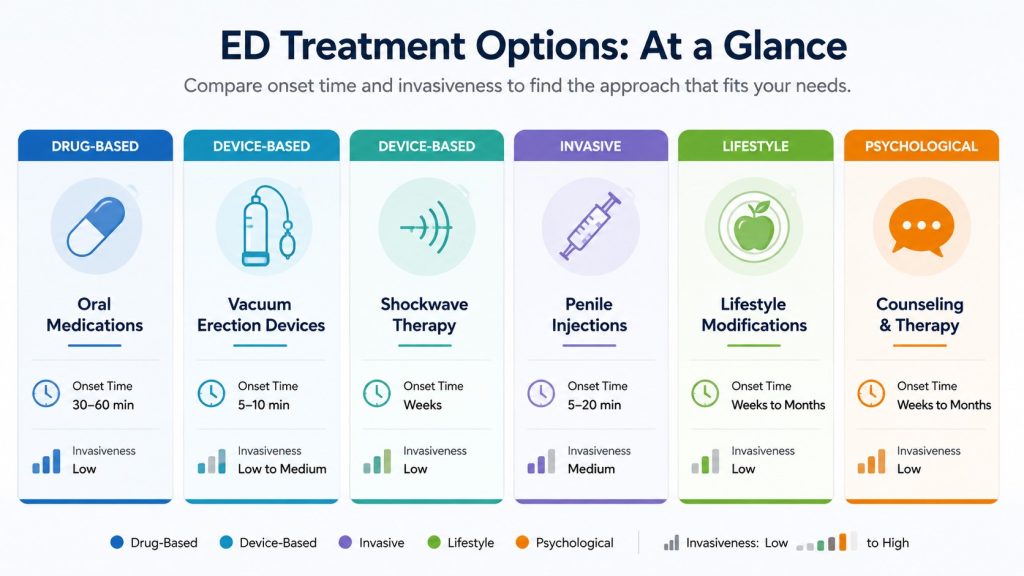
Comparison Table: Non-Surgical ED Treatments at a Glance
| Treatment | How It Works | Onset Time | Invasiveness | Best Fit |
|---|---|---|---|---|
| Oral medications (PDE5 inhibitors) | Relaxes blood vessels to improve blood flow during arousal | 30–60 minutes before activity | Low (pill) | Mild to moderate ED, vascular cause |
| Vacuum erection device | Mechanically draws blood into tissue | A few minutes before activity | Low, non-drug | Men who can’t take oral meds, or prefer drug-free option |
| Low-intensity shockwave therapy | Stimulates blood vessel growth over a treatment course | Weeks (course-based) | Low, non-invasive | Poor response to pills, vascular ED |
| Penile injection therapy | Directly delivers medication into penile tissue | Minutes | Moderate (self-injection) | Poor response to oral medication |
| Lifestyle changes | Improves underlying vascular and metabolic health | Weeks to months | None | Mild ED linked to weight or cardiovascular health |
| Counseling/therapy | Addresses psychological and relational causes | Weeks to months | None | Psychological or situational ED |
Book a Consultation: https://acrtbd.com/contact/
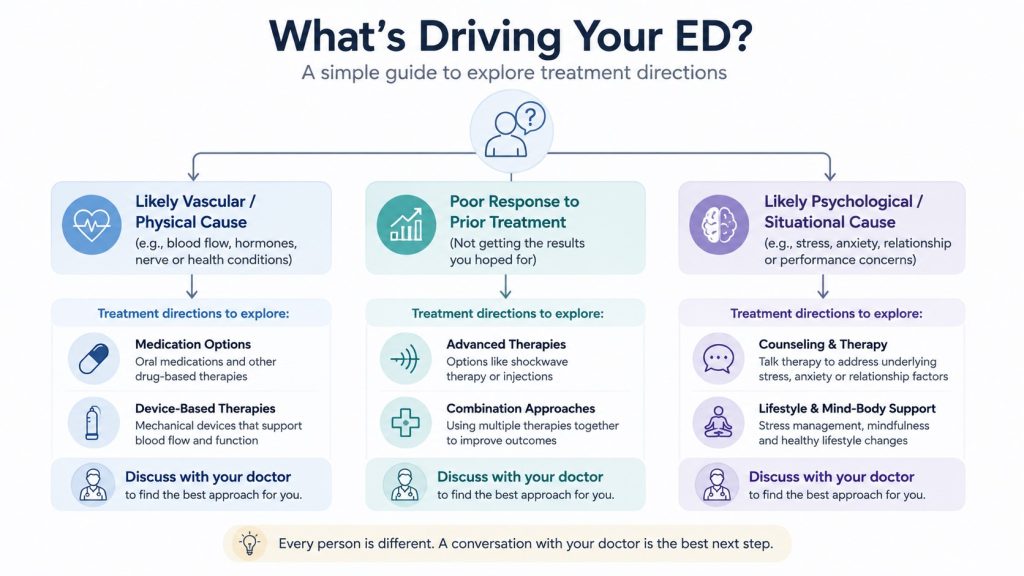
How to Decide Which Treatment Is Right for You
There’s no universal “best” option here, but there is a logical way to narrow things down. Ask yourself these questions, ideally alongside a doctor:
- Is my ED constant or situational? If it happens in every situation, the cause is more likely physical. If it’s inconsistent, especially if you get erections during sleep or masturbation but not with a partner, psychological factors may be playing a bigger role.
- Do I have underlying health conditions? Diabetes, high blood pressure, high cholesterol, and cardiovascular disease all affect blood flow and change which treatments are likely to help.
- Have I tried oral medication already? If PDE5 inhibitors haven’t worked or caused side effects, that narrows things toward shockwave therapy, injections, or a device rather than trying yet another pill.
- How comfortable am I with the method itself? Some men are fine with self-injection. Others aren’t, and that’s a completely valid reason to choose a different path.
- Am I willing to commit to a process, or do I need something immediate? Lifestyle changes and shockwave therapy take time to show results. Medication and injections work on demand.
This isn’t a substitute for diagnosis. It’s a way to walk into a medical consultation already thinking clearly about your own situation, instead of just picking whatever treatment you saw advertised most recently.
Common Mistakes When Choosing an ED Treatment
- Self-diagnosing without ruling out underlying conditions. ED can be an early warning sign of cardiovascular disease or diabetes. Treating the symptom without checking the cause means potentially missing something more serious.
- Buying medication from unverified online sources. Counterfeit or unregulated ED medications are a real risk, and dosing without medical guidance can be dangerous, especially if you’re on other medications.
- Stopping treatment too early. Shockwave therapy and lifestyle changes both take weeks or months to show results. Giving up after a week or two isn’t a fair test.
- Ignoring the psychological side. Men often assume ED is purely physical and skip the conversation about stress, anxiety, or relationship factors, even when those are clearly contributing.
- Not disclosing other medications. Certain heart medications, especially nitrates, can interact dangerously with PDE5 inhibitors. This is a conversation to have honestly with your doctor, not something to guess at.
Practical Tips Before Starting Any Non-Surgical Treatment
- Get a proper medical evaluation first, including blood pressure, blood sugar, and cholesterol checks. ED is often connected to broader health issues.
- Be honest with your doctor about every medication and supplement you’re taking.
- Set realistic expectations. Some treatments work in minutes, others take weeks of consistent use before you notice a difference.
- Don’t assume one failed treatment means nothing will work. Different treatments target different causes.
- If cost or accessibility is a concern, ask your provider about which options are realistic for your situation rather than assuming the most expensive one is automatically the best.
When Non-Surgical Treatment May Not Be Enough
For most men, one of the treatments above, or a combination of them, will make a real difference. But there are cases where non-surgical treatment doesn’t provide enough improvement. This tends to happen with severe vascular damage, significant nerve damage from conditions like prostate surgery, or ED that hasn’t responded to multiple non-surgical approaches over a reasonable period of time.
If that sounds like your situation, it’s worth having a direct conversation with a urologist about whether a penile implant or another surgical option makes sense. This isn’t something to self-assess. It requires a proper clinical evaluation.
Getting Personalized Guidance from ACRT BD
The honest answer to “which non-surgical ED treatment works best” is: it depends on what’s causing your ED in the first place. A proper evaluation, not guesswork, is what actually determines whether medication, shockwave therapy, a device, or a combination approach makes sense for you.
At ACRT BD, this evaluation is the starting point rather than an afterthought. Instead of jumping straight to a treatment based on what’s popular or most advertised, the goal is to understand your specific case, your health history, and your underlying cause, and match that to a treatment approach that’s actually appropriate for you.
Key Takeaways
- There’s no single “best” non-surgical ED treatment. The right one depends on your underlying cause, severity, and personal comfort with the method.
- Oral medications are usually the starting point, but they don’t work for everyone and don’t address the underlying cause.
- Shockwave therapy, injections, and devices are worth considering if pills haven’t worked or aren’t an option for you.
- Lifestyle changes and psychological support often matter more than people expect, either as standalone treatment or alongside another method.
- A proper medical evaluation is the real deciding factor, not trial and error.
FAQs
What is the most effective non-surgical treatment for ED?
There isn’t one universally most effective option. Oral medications work well for many men with mild to moderate ED and a vascular cause, but effectiveness depends heavily on what’s causing the ED in the first place. Men who don’t respond to medication often see better results with shockwave therapy, injections, or a combination approach identified through proper evaluation.
Is shockwave therapy better than medication for ED?
Not necessarily better, just different. Medication provides a temporary effect on demand, while shockwave therapy aims to improve underlying blood vessel function over a treatment course. It’s important to note shockwave therapy isn’t FDA-approved specifically for ED, though it’s widely used off-label with growing supporting research.
Can lifestyle changes alone fix erectile dysfunction?
For some men with mild ED linked to weight, poor cardiovascular health, or inactivity, lifestyle changes alone can lead to noticeable improvement. For moderate to severe ED, lifestyle changes usually work best as a foundation alongside another treatment rather than as a standalone fix.
How long does it take for non-surgical ED treatments to work?
It varies widely. Oral medications and injections typically work within 30 to 60 minutes of use. Shockwave therapy usually requires several weeks of sessions before results become noticeable. Lifestyle changes often take weeks to months of consistent effort.
When should I consider surgery instead of non-surgical treatment?
Surgery is typically considered when non-surgical treatments haven’t provided adequate results after a reasonable trial period, or when there’s significant physical damage to erectile tissue or nerves that non-surgical options can’t address. This decision should be made with a urologist after a full evaluation, not on your own.
Conclusion
Choosing between non-surgical ED treatments isn’t about finding the one option that works for everyone. It’s about understanding what’s driving your ED and matching that to the right approach, whether that’s medication, a device, shockwave therapy, injections, lifestyle changes, or some combination of these. What works well for one man may do very little for another, and that’s normal.
If you’re not sure where to start, getting a proper evaluation is the most useful first step you can take. ACRT BD can help you work through that process and find a treatment path that actually fits your situation. If you’re ready to move forward, book a consultation and get an assessment based on your specific case rather than guesswork.
Book a Consultation: https://acrtbd.com/contact/