ACRT BD | Mr. Shamsul Hoque Nadim, a Regenerative Therapy Practitioner | Baridhara DOHS, Gulshan, Dhaka
Pain that never really goes away is exhausting. You try painkillers for a few months. They help a little, but then the stomach problems start. Someone suggests surgery. But the recovery looks long, the risks feel scary, and honestly, you’re not even sure surgery is the right answer.
Here’s the thing: for most types of chronic musculoskeletal pain, surgery is often not the first answer. And in 2026, the non-surgical options have gotten genuinely good.
This article walks you through what actually works, what the science says, and how to figure out which treatment makes sense for your specific type of pain.
What Is Chronic Pain, Exactly?
Pain becomes “chronic” when it lasts more than 3 months. At that point, your nervous system has often rewired itself around the pain signal. The original injury may have healed, but the pain keeps coming back or never fully leaves.
Common sources of chronic pain include:
- Knee osteoarthritis
- Plantar fasciitis (heel pain)
- Lower back pain
- Shoulder tendinopathy
- Hip pain
- Tennis elbow / golfer’s elbow
- Neck pain from posture or disc issues
These conditions respond well to regenerative and physical therapies. Most people with these diagnoses do not need surgery. What they need is the right treatment, delivered at the right time.
Why Many People Stay in Pain Too Long
Most people with chronic pain follow a similar path:
- Take painkillers or anti-inflammatories (NSAIDs)
- Rest, which helps a bit, but the pain returns
- Get physiotherapy, sometimes inconsistently
- Consider surgery out of frustration
- Worry about surgery risks, delay, stay stuck
The problem is not that the treatments don’t exist. It’s that most people don’t know about the newer options, or they’re told surgery is the only “real” fix. That’s changing.
The Best Non-Surgical Treatments for Chronic Pain in 2026
1. Focused Shockwave Therapy (FSWT)
This is one of the most effective non-surgical treatments available right now for musculoskeletal pain.
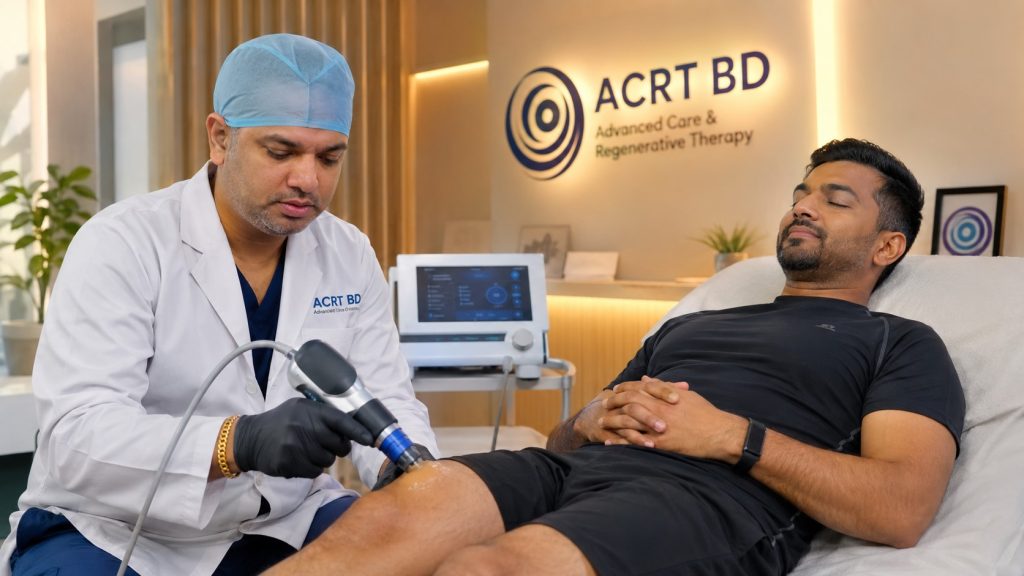
Shockwave therapy sends focused acoustic energy (sound waves) deep into damaged tissue. These waves trigger your body’s own healing response. Blood flow increases. Old scar tissue breaks down. Collagen production goes up. The tissue starts repairing itself.
It’s particularly effective for:
- Plantar fasciitis
- Calcific shoulder tendinitis
- Patellar tendinopathy (knee pain below the kneecap)
- Tennis elbow
- Achilles tendinopathy
- Chronic lower back pain
Clinical research consistently shows response rates of 70–80% for conditions like plantar fasciitis and calcific tendinitis with focused shockwave therapy. Studies published in journals like the Journal of Orthopaedic Research and BMC Musculoskeletal Disorders have confirmed its effectiveness.
Sessions typically take 20–30 minutes. Most people need 3–6 sessions. There’s no downtime. You can go back to your normal routine the same day.
At ACRT BD, we use Extracorporeal Focused Shockwave Therapy with medical-grade equipment specifically designed for musculoskeletal conditions.
2. Platelet-Rich Plasma (PRP) Therapy
PRP uses your own blood to heal your own body. A small amount of blood is drawn, put in a centrifuge to concentrate the healing platelets, and then injected directly into the painful area.
Platelets carry growth factors. Those growth factors stimulate tissue repair, reduce inflammation, and support new blood vessel formation in damaged areas.
PRP works particularly well for:
- Knee osteoarthritis
- Tendon injuries
- Partial ligament tears
- Hip pain
- Rotator cuff issues
Multiple clinical trials have shown PRP to be more effective than corticosteroid injections for knee osteoarthritis pain over 6–12 months. Unlike steroids, which reduce pain temporarily but can damage cartilage over time, PRP supports actual tissue regeneration.
It’s a one-time procedure or a short series of 2–3 injections. Recovery is minimal. Most patients notice improvement within 4–8 weeks.
Learn more about Platelet-Rich Plasma (PRP) therapy at ACRT BD.
3. TECAR Radiofrequency Therapy
TECAR (Transfer of Energy Capacitive and Resistive) is a deep-tissue therapy that uses electrical energy to heat tissue from the inside.
Unlike a heating pad that warms only the surface, TECAR energy goes deep into muscles, tendons, and joints. This increases local circulation, speeds up cellular metabolism, and accelerates tissue recovery.
It works well for:
- Muscle pain and tightness
- Joint stiffness
- Post-injury rehabilitation
- Chronic neck and back pain
- Sports-related soft tissue injuries
TECAR is often combined with manual therapy or exercise for better results. It’s painless, non-invasive, and most people describe it as a warm, comfortable sensation during the session.
Explore TECAR Radiofrequency Therapy at ACRT BD.
4. Viscosupplementation (Hyaluronic Acid Injections)
If you have knee osteoarthritis specifically, viscosupplementation is worth knowing about.
Your knee joint naturally produces synovial fluid, which acts as a lubricant and shock absorber. In osteoarthritis, this fluid becomes thin and watery. Viscosupplementation replaces or supplements it with hyaluronic acid injections directly into the joint.
Results vary by patient, but many people with mild-to-moderate knee OA experience significantly reduced pain and improved mobility for 6 months to a year from a single treatment course.
It’s particularly useful when:
- Other conservative treatments haven’t fully worked
- The patient wants to delay or avoid surgery
- Pain is limiting daily activities like walking or climbing stairs
We cover this in more detail in our article on knee osteoarthritis and heel pain treatment.
See our Viscosupplementation page for more details.
5. Structured Physiotherapy and Exercise Rehabilitation
This one might sound basic, but it’s foundational. Proper physiotherapy done consistently is still one of the most evidence-based treatments for chronic pain.
The key word is “structured.” Random exercises you find online are not the same as a tailored rehabilitation program built around your specific condition, movement patterns, and strength deficits.
For conditions like lower back pain, hip osteoarthritis, and shoulder issues, a structured 8–12 week exercise program can reduce pain by 40–60% and significantly improve function.
The challenge is consistency and guidance. Physiotherapy works best when it’s supervised, progressively loaded, and combined with other treatments like TECAR or shockwave therapy when needed.
Comparing Your Options
| Treatment | Best For | Sessions Needed | Downtime |
|---|---|---|---|
| Focused Shockwave Therapy | Tendon pain, heel pain, calcification | 3–6 | None |
| PRP Therapy | Knee OA, tendon injuries, ligament issues | 1–3 | Minimal (1–2 days) |
| TECAR Radiofrequency | Muscle pain, stiffness, rehabilitation | 5–10 | None |
| Viscosupplementation | Knee OA specifically | 1–3 | None |
| Physiotherapy | All conditions (as foundation) | 12–24 | None |
What About Painkillers and Steroid Injections?
Painkillers (NSAIDs like ibuprofen or naproxen) reduce inflammation and temporarily control pain. They’re not a treatment. They don’t fix the underlying problem.
Long-term NSAID use is associated with stomach ulcers, kidney stress, and cardiovascular issues.
Corticosteroid injections work similarly: fast relief, but they do nothing to repair tissue. Repeated steroid injections can actually weaken tendons and cartilage over time.
Both have a place in short-term pain management, but neither is a solution for chronic pain.
When Does Someone Actually Need Surgery?
Surgery for musculoskeletal pain is appropriate when:
- Structural damage is severe and irreversible (e.g., bone-on-bone knee OA at advanced stage)
- There’s a complete tear of a major tendon or ligament
- Conservative treatment has genuinely failed over 6–12 months
- There’s nerve compression causing weakness or loss of function (like serious spinal stenosis)
For the vast majority of people presenting with chronic pain, none of these apply. Surgery is being chosen too soon in many cases, often because patients don’t know the alternatives.
Chronic Pain in Dhaka: A Local Reality
In Bangladesh, chronic pain is extremely common, but quality treatment options have historically been limited to painkillers, basic physiotherapy, or surgery. Regenerative therapies were mostly unavailable outside of specialty centers.
That’s changing. ACRT BD in Baridhara DOHS, Gulshan, Dhaka, now offers all of the treatments listed above under one roof, delivered by Mr. Shamsul Hoque Nadim, a certified Regenerative Therapy Practitioner (BPT, Dhaka University; ISMST certified) with 10 years of clinical experience in musculoskeletal conditions.
We also have detailed guides on chronic pain treatment options near Dhaka for patients who want to understand their full range of options.
How to Choose the Right Treatment for Your Pain
Here’s a simple way to think about it:
Pain in a tendon or heel? Start with Focused Shockwave Therapy. It has the most direct evidence for those conditions.
Knee osteoarthritis with joint stiffness? PRP and/or Viscosupplementation are likely the best fit, depending on the severity.
Muscle pain, stiffness, or recovering from injury? TECAR Radiofrequency combined with physiotherapy works well.
Multiple overlapping problems? A proper clinical evaluation is the only way to build a treatment plan that actually makes sense. Don’t guess.
A good practitioner will assess you first, explain the likely mechanism of your pain, and then recommend treatments based on evidence and your specific situation — not just what’s available.
Questions People Usually Ask
How long does it take to see results? Shockwave therapy usually produces noticeable change within 3–6 sessions over 3–6 weeks. PRP takes 4–8 weeks to show full effect. TECAR provides faster symptomatic relief, sometimes within the first week.
Are these treatments painful? Shockwave therapy can feel intense during the session but is well-tolerated. PRP involves a needle injection and local discomfort for 1–2 days after. TECAR is comfortable throughout.
Are they permanent? Not necessarily. But they address the underlying issue rather than masking it. Many patients maintain results for 1–2 years or longer, especially when combined with lifestyle and movement changes.
How much does treatment cost in Dhaka? Costs vary based on the specific treatment, number of sessions, and individual case. Contact ACRT BD to discuss options.
The Bottom Line
Chronic pain does not have to end with surgery. In 2026, the non-surgical options are genuinely effective, well-researched, and available in Dhaka.
If you’ve been living with persistent pain and you’re still waiting for it to just go away on its own, or you’re being told surgery is the only option, it’s worth getting a second opinion from a regenerative medicine specialist.
See the full list of treatments available at ACRT BD, or book a consultation to talk through your specific situation.
About ACRT BD Advanced Centre for Regenerative Therapy (ACRT BD) is located in Baridhara DOHS, Gulshan, Dhaka. The clinic specializes in non-surgical regenerative treatments for musculoskeletal pain and men’s health. Learn more on our about page.