
Not all knee pain is the same. Some people wake up with stiff, achy knees that get better after moving around for a bit. Others feel a sharp, sudden pain after a fall or a twist, and the knee swells up almost right away. These two situations look similar from the outside, but they come from very different causes and need very different treatment.
Knowing which one you’re dealing with isn’t just useful. It can actually change how fast you recover.
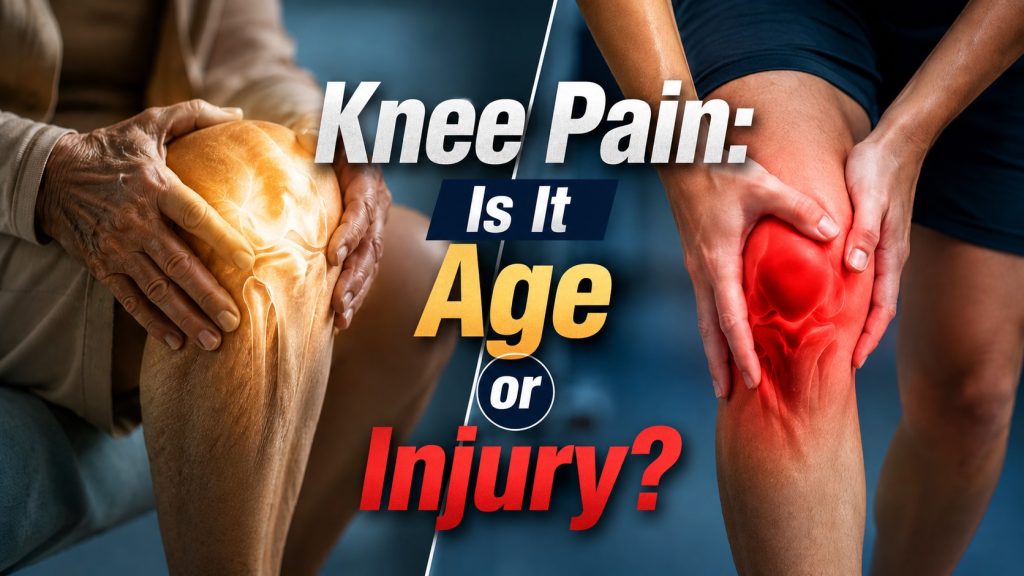
The Two Most Common Reasons for Knee Pain
1. Age-Related Wear and Tear (Osteoarthritis)
Your knee joint has a smooth layer of cartilage that cushions the bones and helps them move without grinding against each other. Over time, that cartilage wears down. This is called osteoarthritis, and it’s the most common type of knee problem in people over 40.
It doesn’t happen overnight. Osteoarthritis builds up slowly, and the symptoms usually follow the same pattern:
- Morning stiffness that eases after you start moving
- A dull, deep ache around the knee
- Pain that gets worse after long walks, climbing stairs, or sitting for too long
- A feeling of the knee being “heavy” or tired
The key thing to know: osteoarthritis pain is gradual. It doesn’t usually start with a single bad moment. It creeps up over months or years.
2. Injury to the Ligaments or Meniscus
The knee has four major ligaments holding it together, plus two pieces of cartilage called the menisci that act as shock absorbers. These can tear during sports, a sudden twist, or even stepping the wrong way.
When this happens, the signs are usually very different from osteoarthritis:
- A sharp, sudden pain, often with a “pop” sound
- Swelling that comes on quickly, sometimes within hours
- The knee buckling or giving way when you try to stand
- Difficulty straightening the leg fully
This type of injury tends to happen to younger, more active people, but it can happen at any age.
What Confuses Most People
Here’s where it gets tricky. You can have both at the same time. Someone with mild osteoarthritis might also tear a meniscus during a fall. Or someone young might develop early-stage joint damage from years of poor posture or carrying extra weight, without any clear injury moment.
That’s why diagnosing yourself based on symptoms alone isn’t reliable. A proper clinical evaluation, and in some cases an MRI, is the only way to know for sure what’s going on inside the joint.
Red Flags That Mean You Should Not Wait
Some symptoms tell you it’s time to get checked without delay:
- Your knee swells up after an activity or even while resting
- You hear clicking or grinding sounds when you move
- Your knee feels like it “locks” in place and won’t bend or straighten
- Pain wakes you up at night
- You’ve been putting up with knee pain for more than a few weeks and it isn’t getting better
Any of these is your body telling you that something needs attention. Pushing through the pain and hoping it resolves on its own often makes things worse, not better.
Does It Matter to Know the Difference?
Yes, very much. Treating osteoarthritis and a ligament injury the same way can actually slow down your recovery or cause more harm.
For age-related wear and tear, regenerative treatments like PRP (Platelet-Rich Plasma), focused shockwave therapy, and viscosupplementation work very well. These treatments encourage the body to repair and rebuild damaged tissue without surgery.
For ligament or meniscus injuries, the approach depends on how severe the tear is. Many partial tears respond well to regenerative therapy as well, which means you may not need surgery even after an injury.
The point is, the right treatment starts with the right diagnosis.
What ACRT BD Does Differently
At ACRT BD, Mr. Shamsul Hoque Nadim takes time to understand your full clinical picture before recommending any treatment. He looks at how long you’ve had the pain, what makes it better or worse, and what daily activities it’s affecting. That context matters more than any single test result.
If you’ve been dealing with knee pain and you’re not sure what’s causing it, that’s the right starting point: get a proper evaluation. You can reach out on WhatsApp at 01977656237 or visit acrtbd.com to learn more about available treatment options.
One Response