
This article is for general education and isn’t a substitute for a personal medical evaluation. If you’re dealing with ED, talk to a doctor about your specific situation.
If you’re in your 20s or 30s and dealing with erectile dysfunction, you’ve probably already Googled it late at night, read a dozen conflicting answers, and closed the tab feeling more confused than before. Maybe you’re wondering if something is seriously wrong with you, or if this is just something that happens to older men and you’re somehow broken for having it early.
Here’s the short version: ED in young men is more common than most people assume, and it’s rarely a mystery once you look at the actual causes. The confusion usually comes from silence, not from the condition itself. Most men just don’t talk about it, so nobody realizes how normal it is to have questions.
This article breaks down why ED shows up in younger men, what’s actually driving it, and how to figure out whether it’s something to manage yourself or something to get checked out.
Book a Consultation: https://acrtbd.com/contact/
Is Erectile Dysfunction Actually More Common in Young Men Now?
Yes, doctors and sexual health clinics report seeing more men under 40 with ED complaints than in previous decades. That doesn’t necessarily mean the underlying biology of young men has changed. It’s more likely a mix of two things: genuine increases in certain risk factors (more sedentary lifestyles, higher stress, changing health patterns) and more men actually speaking up about a problem that used to go unreported out of embarrassment.
There isn’t reliable, specific data on ED prevalence for Bangladesh alone, so be cautious of any article or source that throws out a precise percentage for the country. What’s clear from broader research is that ED in men under 40 is common enough that clinics dedicated to it exist in most major cities, including Dhaka.
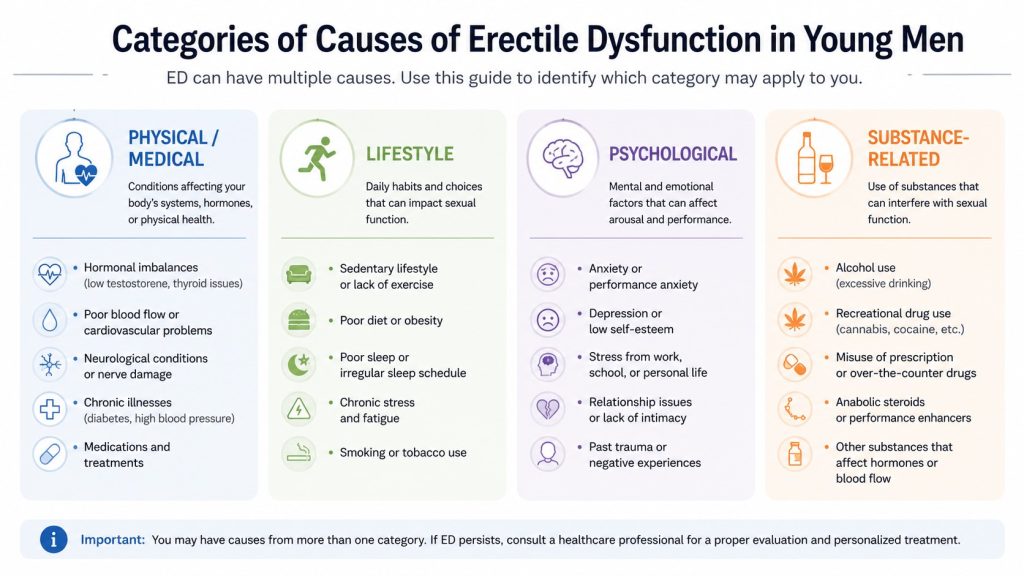
Physical and Medical Causes
Erections depend on healthy blood flow, working nerves, and balanced hormones. When any of those systems are under strain, even a young, otherwise healthy man can experience ED. A few of the most relevant physical causes for younger patients:
Poor blood flow. An erection is basically a plumbing problem in the best sense: blood needs to flow in and stay in. Anything that affects your blood vessels, even early-stage issues that haven’t caused other symptoms yet, can affect erections before it affects anything else you’d notice.
Diabetes and prediabetes. Blood sugar problems are becoming more common at younger ages, partly due to diet and lifestyle changes across urban Bangladesh. High blood sugar damages blood vessels and nerves over time, and ED is often one of the earliest signs, sometimes showing up before someone even knows they’re prediabetic.
High blood pressure. Like diabetes, hypertension is showing up earlier in life than it used to. It affects the same blood vessels responsible for erections.
Obesity and low activity levels. Extra body weight, especially around the midsection, is linked to lower testosterone and reduced blood flow, both of which play a direct role in erectile function.
Hormonal imbalances. Low testosterone doesn’t only happen to older men. Sleep problems, chronic stress, and certain medical conditions can all suppress testosterone in men in their 20s and 30s.
Lifestyle Factors Unique to Young Men Today
A lot of what’s driving ED in younger men isn’t a dramatic medical event. It’s the accumulation of everyday habits that are more common now than a generation ago.
Smoking and vaping. Nicotine constricts blood vessels. Regular smoking, including vaping, restricts the blood flow an erection depends on. This is one of the most well-established, directly reversible causes of ED.
Sedentary desk jobs. More young men in Bangladesh now work in offices, sitting for eight or more hours a day. Long periods of inactivity are linked to poorer cardiovascular health, which affects erectile function over time.
Poor sleep. Testosterone is largely produced during deep sleep. Chronic short sleep, common among young professionals juggling long commutes and late work hours, can meaningfully lower testosterone levels.
Heavy alcohol use. Occasional drinking usually isn’t the issue. Regular heavy drinking affects both the nervous system and hormone levels, and can cause both short-term and longer-term erectile problems.
Psychological and Stress-Related Causes
Not every case of ED starts in the body. For a lot of younger men, the first trigger is mental, and then it becomes a cycle that’s hard to break out of on your own.
Performance Anxiety and Expectations
Once a man experiences one instance of ED, whether from stress, fatigue, or alcohol, it’s common to start worrying it will happen again. That worry itself can cause the next episode, creating a loop of anxiety and dysfunction that has nothing to do with physical health. Unrealistic expectations, often shaped by pornography or unrealistic online content, can also create pressure that makes sex feel like a performance to get right rather than something to enjoy, which adds to the anxiety.
Financial and Career Pressure
Dhaka’s job market is competitive, and financial pressure on young men, especially those supporting families, is real and constant. Chronic stress raises cortisol, and elevated cortisol over time can suppress testosterone and libido. This isn’t “just stress” in a dismissive sense. It has a measurable physical effect on the same systems responsible for erections.
Substance Use and ED
Certain substances, both recreational and prescription, are known to interfere with erectile function. This isn’t a call-out or a moral judgment, just a factual note: recreational drug use and misuse of certain prescription medications can directly affect the nervous system and blood flow involved in erections. If substance use is part of your situation, a doctor needs to know this to give you accurate guidance, and a confidential consultation is the right place to bring it up rather than trying to self-manage it.
Common Mistakes Young Men Make When Dealing With ED
Buying unregulated pills without a prescription. Online ads for “instant” ED solutions are everywhere, and many of these products aren’t verified, dosed correctly, or even honest about their ingredients. Taking something you don’t understand, especially alongside other medications, can be genuinely risky.
Ignoring it out of embarrassment. Delaying a conversation with a doctor doesn’t make the underlying cause go away. If ED is an early sign of diabetes or heart issues, waiting means the underlying condition also goes unaddressed.
Assuming it’s “all in your head.” Some men jump straight to psychological explanations because it feels less alarming than a medical one. The truth is usually more useful: an evaluation can tell you which category you’re actually dealing with instead of guessing.
Avoiding the conversation with a partner. ED often creates more relationship strain through silence and avoidance than through the condition itself. A short, honest conversation usually reduces pressure on both people.
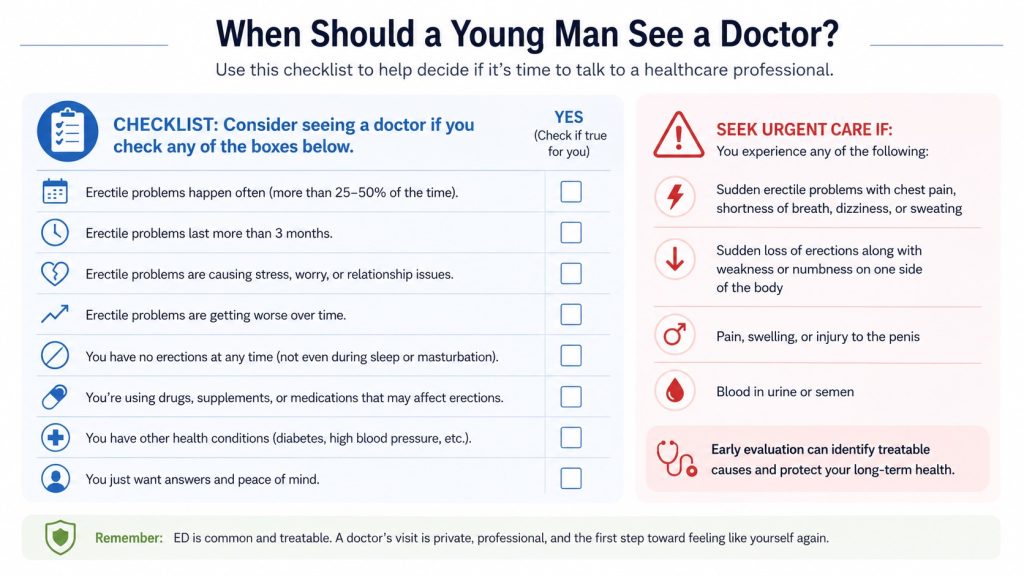
When Should a Young Man See a Doctor?
You don’t need to wait until it feels like a crisis. A few signs it’s worth getting checked out:
- ED has happened repeatedly over several weeks, not just once or twice
- It’s happening alongside other changes, like fatigue, weight changes, or reduced interest in sex
- It’s affecting your confidence, mood, or relationship
- You’ve already tried obvious lifestyle fixes (sleep, less alcohol, less stress) without improvement
None of these mean something is seriously wrong. They just mean it’s time for an actual evaluation instead of more guessing.
Book a Consultation: https://acrtbd.com/contact/
How ED Is Diagnosed and Treated
A proper evaluation usually starts with a conversation about your health history, lifestyle, and when the ED started, followed by basic checks for underlying conditions like blood sugar, blood pressure, or hormone levels. From there, treatment depends entirely on the cause.
For lifestyle-driven ED, the first step is often addressing the habit directly: quitting smoking, improving sleep, cutting back on alcohol, or managing weight. For psychological causes, therapy or counseling focused on anxiety and expectations can help break the cycle. When there’s an underlying medical condition, treating that condition is usually the most effective path.
Clinics like ACRT BD in Dhaka offer confidential consultations specifically for ED and related concerns, along with treatment options such as shockwave therapy and the P-Shot (a PRP-based treatment). These are worth discussing with a specialist as part of a broader evaluation, not as a first-line fix before you understand what’s actually causing your ED. No treatment, including these, should be assumed to work the same way for everyone, and a doctor can walk you through realistic expectations based on your specific case.
Key Takeaways
- ED in young men is common and usually explainable, not a sign that something is fundamentally wrong
- Physical causes include blood flow issues, diabetes, high blood pressure, obesity, and hormonal imbalances
- Lifestyle factors like smoking, poor sleep, heavy drinking, and sedentary work all play a real role
- Psychological causes, especially performance anxiety and chronic stress, are just as common as physical ones
- A proper evaluation, not self-medication or silence, is the fastest way to actually understand what’s going on
Frequently Asked Questions
Is erectile dysfunction common in men under 30? Yes. While exact figures for Bangladesh aren’t well documented, clinics worldwide report a steady number of ED patients in their 20s and 30s. It’s often linked to lifestyle factors, stress, or early-stage health issues rather than anything unusual about the individual.
Can lifestyle changes alone fix ED in young men? Often, yes, especially when the cause is smoking, poor sleep, heavy drinking, or lack of exercise. Improvements can take several weeks to a few months to show. If lifestyle changes alone don’t help after a reasonable period, it’s worth getting a medical evaluation to rule out other causes.
Does stress really cause erectile dysfunction? Yes. Chronic stress raises cortisol levels, which can suppress testosterone and reduce libido and erectile function. Performance anxiety specifically can also trigger ED on its own, separate from any physical cause.
Is ED in young men usually psychological or physical? It varies, and often it’s both at once. A single stressful or difficult experience can trigger a psychological cycle, even when the original cause was physical (like fatigue or alcohol). This is exactly why a proper evaluation matters instead of assuming one cause.
When should a young man in Bangladesh see a specialist for ED? If ED has happened repeatedly over several weeks, occurs alongside other symptoms like fatigue or weight changes, or is affecting your confidence or relationship, it’s time to see a specialist. Confidential, judgment-free consultations are available specifically for this at clinics like ACRT BD in Dhaka.
A Final Word
ED in young men isn’t a rare, shameful problem. It’s a common medical issue with identifiable causes, most of which respond well to the right combination of lifestyle changes, mental health support, or medical treatment. The biggest mistake isn’t having ED. It’s staying silent about it for months or years out of embarrassment.
If you’ve noticed this happening to you, the most useful next step is a real conversation with someone qualified to evaluate it, not another late-night search session. If you’re not sure where to start, here’s a guide on finding the right ED specialist in Dhaka. ACRT BD offers confidential consultations specifically for concerns like this, and getting an accurate picture of what’s going on is the fastest way to actually address it.
Book a Consultation: https://acrtbd.com/contact/

2 Responses